Absence and the Void
House of LeavesAbsence and the Void is not merely the lack of an object or an answer in The Navidson Record. It is a governing condition of the house and of the documentary’s perception of it: emptiness produces the clearest echoes, darkness prevents space from becoming legible, and silence turns an apparently architectural environment into something almost outside the world. The void is therefore both a physical expanse and a crisis of knowledge. It offers no stable boundary, yet its very refusal to disclose itself repeatedly forces the people who enter it to measure what remains of their bodies, memories, relationships, and identities.
Emptiness as Acoustic and Spatial Condition
An echo depends on absence. Objects muffle or obstruct acoustic reflection, whereas an empty place can return a sound with unusual clarity. This physical principle gives emptiness an interpretive force: the void does not simply contain nothing, but makes recurrence possible. A voice returns after a delay, altered and fragmented, creating the impression that another presence inhabits a place that must, by definition, be deserted. The result is a double experience. The echo is uncanny because it seems external to the self, even ghostly; yet it can also comfort because it suggests that something remains beyond isolation, however imaginary or mechanically produced by a wall.
The same paradox appears in the relation between echo and sacred space. Choral singing and recorded Psalms commonly rely on generous reverberation, so that divinity seems to reside in the province of the hollow. An echo implies an enormous space, but it also defines and limits that space by temporarily inhabiting it. The sound is thus a provisional form of vision: when a pebble falls into a well, the eventual plunk confirms a depth that the eye cannot see, while the absence of any sound leaves the descent disquietingly unconfirmed. In the house, vocal repetition performs this same work, turning speech into an instrument for testing whether the unseen has an edge.
The House Beyond Legibility
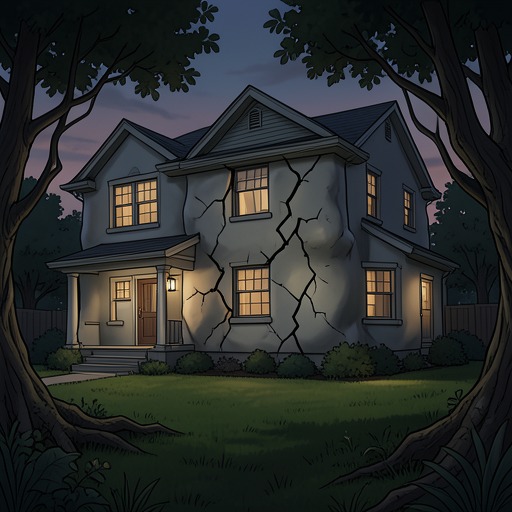
The void becomes materially visible through the house’s impossible corridors. Navidson’s flashlight and camera move across ceiling and floor, entering small rooms, alcoves, and closet-like spaces that contain no clothing. The light never reaches the converging point promised by ordinary perspective. Instead, the passage continues indefinitely, producing one smooth corner and wall after another, each unreadable and perfectly finished. The architecture is not a ruin whose missing parts explain its emptiness; it is a relentless production of spaces that look complete while refusing completion.
At the end of one such passage, Navidson reaches an entrance larger than the others. It arches above him and opens onto blackness in which the flashlight can find a floor but neither walls nor ceiling. The discovery changes the scale of the house: what had seemed like an anomalous corridor becomes an opening onto an immeasurable interior. Its dimensions cannot be secured by sight because illumination dies before it can determine an endpoint. The void is therefore not simply dark space but space that defeats the procedures by which space normally becomes knowable.
The house nevertheless retains a limited set of constants. Its temperature remains approximately 32 degrees Fahrenheit, varying by eight degrees; light is absent; silence is complete; there is no air movement, including breezes or drafts; and true north does not exist. These details give the emptiness the cold precision of a report. The void is not described as an undifferentiated supernatural atmosphere alone. It is also recorded through measurements, absences, and failed reference points, as if scientific description could establish a perimeter around what continually withdraws from description.
Repetition, Familiarity, and the Unhomely
The house’s emptiness is made more disturbing by its familiarity. Hallways, corridors, and rooms repeat over and over, creating an environment composed of recognizable architectural units without the objects, inhabitants, or histories that ordinarily make a house a home. It is described as lifeless, objectless, and soulless, and even as godless: an abyss either before God or after God. The repeated forms do not reassure. They make the familiar itself strange by stripping away everything that would connect a room to use, memory, or human presence.
This is why the void converges with the uncanny. The supposedly unhomely can be understood as something familiar that has been estranged through repression; here, the house is endlessly familiar precisely because it endlessly repeats. Emptiness becomes the condition in which familiarity loses its sheltering function. The repeated room is recognizable but cannot be inhabited in the ordinary sense, while the absence of books, souls, and other signs of life turns architecture into a shell whose smooth surfaces resist symbolic attachment.
The narrative’s own repetitions and interruptions reinforce this condition. It approaches the house through echoes, technical observations, citations, recordings, and gaps rather than through a single authoritative account. The absence of a final explanatory shape is not an accidental deficiency in the evidence. It is formally parallel to the house itself: the documentary offers fragments that indicate a vast structure while withholding the totality that would make those fragments cohere.
The Void and the Dissolution of Self
The most severe consequence of absence appears when Navidson’s physical resources and perceptual supports begin to disappear. He reports that he has no more food or water, that the film remains but the flash is dead, that he is cold, and that his feet hurt. The statement reduces the crisis to depleted necessities and failing equipment. The camera can no longer guarantee an image, the body can no longer guarantee endurance, and the documentary’s evidentiary apparatus approaches exhaustion alongside its subject.
He then reports that the slab beneath him has vanished and that he may be floating, falling, or unable to distinguish between the two. The uncertainty is not only about location; it concerns the categories through which location could be understood. He knows he is falling and expects to strike a bottom, but gradually recognizes that he may die before knowing whether impact occurs. For him, there is consequently no bottom—only an end. The void becomes identical with the limit of experience: what exists is not an ascertainable destination but the point at which awareness ceases.
As exposure and delirium advance, Navidson loses any dependable sense of the world beyond himself. He says that he has no sense of anything other than himself, and the narration records the near-total darkness surrounding his deteriorating voice. Yet memory returns through the names of people he has known and loved. He wonders whether Tom has gone there before, recalls Delial and his children, and increasingly addresses Karen while admitting that he has lost her. In the absence of architecture, light, and orientation, relationship becomes the last surviving structure of consciousness, even as that structure is expressed through confusion and loss.
Silence, Blankness, and the Limits of Representation
The void also exposes the limits of the film that claims to document it. Near the climax, the screen provides a still photograph of a window, images of flares falling or hovering in the darkness, and photographs of Navidson reading and burning a book. The remaining material consists largely of audio impressions from his physical decline, while nearly six minutes of screen time are black. Blackness is not a neutral background here. It is the documentary’s most accurate record of what cannot be shown, while also revealing how little a record can preserve when its subject exceeds the conditions of representation.
The final page and the final match compress reading, illumination, and destruction into one act. Navidson reads by match light, then applies the flame to the page as the heat reaches his fingers. The fire consumes the text while his eyes race ahead of the advancing flames; ash falls into the surrounding emptiness, and when the light dies the book is gone, leaving only invisible traces already dismantled in the dark. Knowledge is momentarily produced by reading, then materially erased by the means that made reading possible. The scene makes absence both the subject and the fate of the record.
The tape ultimately becomes blank. That blankness does not settle what lies below or whether Navidson reaches a physical bottom. Instead, it leaves the reader with a form of evidence that is simultaneously present and unavailable: a recording whose silence marks the point at which narration can no longer continue. Absence and the Void therefore governs the book’s deepest tension. The empty space terrifies because it removes confirmation, but it also generates echoes, memories, and interpretive activity. What cannot be seen or finally explained becomes the very pressure that keeps the story, its witnesses, and its readers listening.